
Chain Link Fence Installation in Thornton, CO
You want a chain link fence in Thornton, and you want it set by a crew that treats it like a real fence instead of a light-duty afterthought. We install galvanized and vinyl-coated chain link across Thornton and Adams County out of our shop on Washington Street in north Thornton, and we set the terminal, corner, and gate posts 36 to 42 inches deep in concrete because our bentonite clay and chinook wind walk a shallow post out of plumb no matter what mesh hangs off it. Family-run, licensed and insured, and the quote you sign is the price you pay.
Here's the pattern we've watched play out for 10-plus years on this ground: chain link doesn't fail because it's chain link, it fails because a crew set the end posts too shallow, hand-pulled the fabric instead of stretching it, and spaced the line posts too far apart to save on holes. The top rail sags, the mesh bags out, and the whole run leans the first hard wind. This page covers galvanized versus vinyl-coated mesh, commercial and agricultural runs, and the post depth, spacing, and tensioning that decide whether a chain link fence in Thornton stands straight in year five.
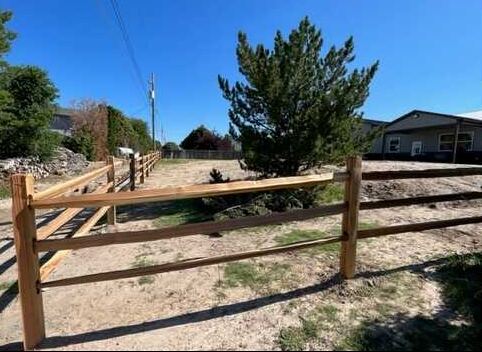
Chain link fence installation in Thornton, CO
Chain link is the budget-friendly, see-through pick in Thornton for dog runs, back property lines, garden enclosures, and utility yards where you want a barrier without blocking the view or the light. A standard residential run is a day to a day and a half on site: dig and set the terminal, corner, and gate posts in concrete, let it cure, then hang the line posts, top rail, and stretched fabric. It's the least expensive fence per foot we install, and that low price is exactly why it gets built wrong so often.
The part that decides everything sits underground and at the corners. Terminal, corner, and gate posts carry the tension of the whole run, so we set them 36 inches minimum into a 50-lb bag of concrete, 42 inches on a 6-foot run, the same depth we give cedar and iron. The Front Range frost line sits at 30 to 36 inches, and a shallow end post heaves out of plumb the first winter and takes the top rail and fabric with it.
We've set dog runs in Trail Winds, back-line fabric in Hunters Glen, and utility enclosures across the north Thornton ZIPs, 80229, 80233, 80241, 80260, 80602, and 80640. Ready when you are, call (303) 915-8649 to price a run.
Galvanized vs vinyl-coated chain link: which mesh for a Thornton yard
The mesh choice is the first real decision on a chain link fence, and the honest answer depends on where the run goes and how it needs to read. After years of installing both across Adams County, here's the split we actually recommend on-site.
- Galvanized (silver) chain link is zinc-coated steel mesh, the classic utility look. It's the least expensive option, it holds up fine on the Front Range, and it's the right call for back property lines, utility yards, kennels, and anywhere appearance takes a back seat to cost.
- Vinyl-coated chain link is the same galvanized mesh with a bonded PVC coating in black or green. It costs a bit more, but the black mesh visually recedes so the fence reads cleaner along a property line, the coating adds a corrosion layer over the galvanizing, and it's what most Thornton HOAs will approve when they allow chain link at all.
Black vinyl-coated mesh is the one homeowners are surprised by: it disappears against a treeline where silver galvanized stands out, so you get a see-through fence that mostly vanishes.
Gauge matters too. We use a heavier 9-gauge fabric on dog runs and commercial lots that take abuse and a lighter 11 or 11.5-gauge where cost is the driver and the run isn't getting leaned on. We'll tell you which fits your lot instead of quoting one gauge for everything. Talk to us about mesh and gauge: (303) 915-8649.
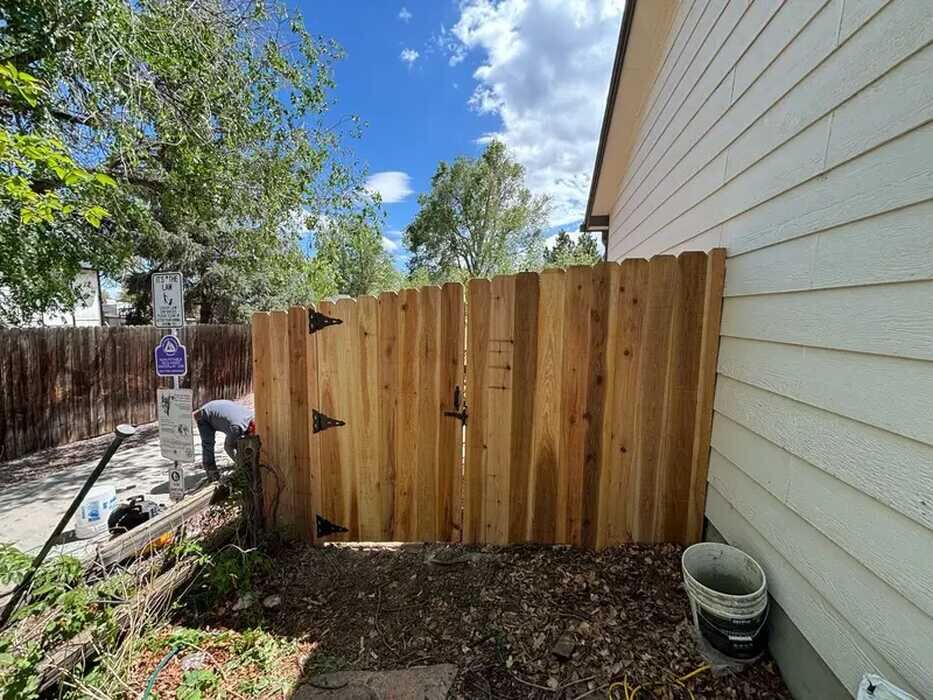
Commercial and agricultural chain link fencing in Adams County
Chain link earns its keep on commercial and agricultural lots, where the job is security and containment on a long perimeter, not curb appeal. We build both across Thornton and Adams County, and the spec steps up from a backyard run.
Commercial and industrial runs are where chain link is still the default: contractor yards, storage lots, equipment compounds, and the fenced perimeters around the medical and retail properties along the Thornton corridors. Those go taller, usually 6 to 8 feet, on heavier-gauge fabric and larger-diameter terminal posts, often with three-strand barbed arms up top and a wide double-drive gate sized for a truck or trailer. Agricultural and property-line runs on the larger lots out toward the county edges lean on the same discipline for a different reason: a long perimeter fence lives or dies on how well its corner and end posts are anchored, because every foot of stretched fabric pulls on them.
If your commercial run tops 6 feet you'll need a permit through the Adams County office, and we pull it on your behalf and call in locates before we dig. Get a written scope for a commercial or ag run: Get a free estimate.
Chain link fence height and gate options
Height and gates are where a chain link fence gets matched to the job, and we spec both by name on the estimate. The heights we build most in Thornton:
- 4-foot: front and side yards, garden enclosures, and low property-line runs where you want a boundary, not a barrier.
- 5-foot: a common middle ground for backyards and dog runs that need a little more containment without going full privacy height.
- 6-foot: dog runs for jumpers, back property lines, and residential security, the tallest we run without a permit.
- 7 to 8-foot: commercial and industrial perimeters, permitted, usually on heavier gauge with barbed arms.
For a dog that jumps or climbs, height alone isn't the fix. A 6-foot run with the bottom tension wire pinned tight to the ground stops the dig-out that most escapes actually come from.
Gates are the part that gets used every day, so they're the part built to last: a single walk gate for a yard entry, a double-drive gate for driveway and equipment access, and rolling cantilever gates on wider commercial openings. Every gate post gets a bag and a half to two bags of concrete because a swinging gate works that post thousands of times, and a loose gate post is how the latch stops catching. We hang each gate square before backfill so it swings clean and latches on the first close. Call (303) 915-8649 to spec height and gates for your run.
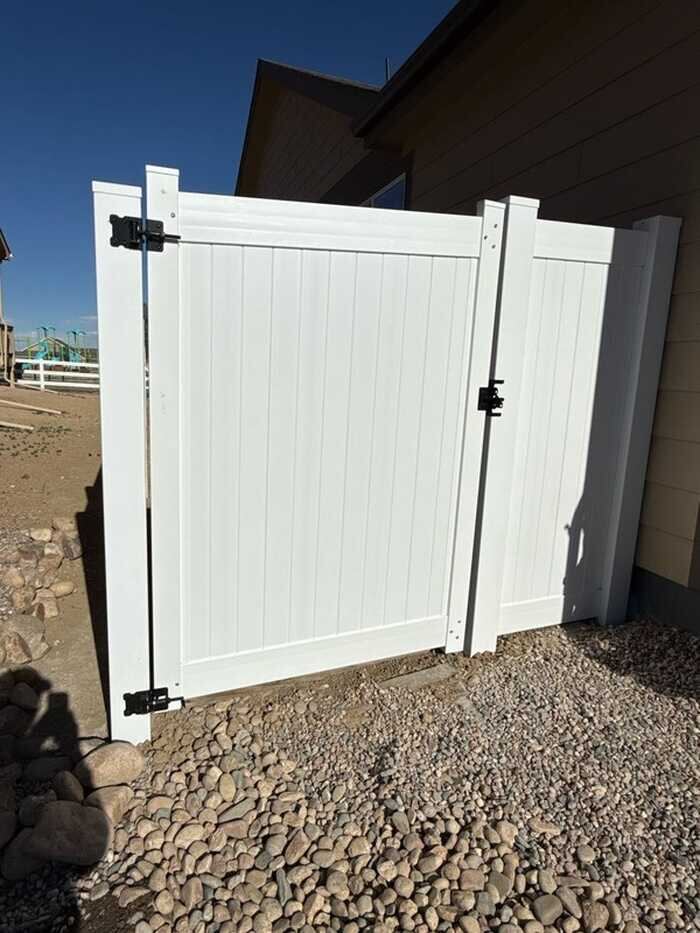
Why chain link posts have to go deep in Thornton
People assume chain link is light enough to set shallow. It's the opposite problem: a chain link run is nothing but tension, and every bit of it lands on the end posts. Set those shallow and the fabric tension slowly levers them inward, the top rail sags, and the whole line goes crooked, no wind required.
Thornton sits on bentonite-heavy expansive clay that swells when wet and shrinks hard when it dries, and the freeze-thaw cycle from October through March grabs a shallow post and walks it out of plumb one winter at a time. So terminal, corner, and gate posts go 36 inches minimum, 42 inches on a 6-foot run, in a full 50-lb bag of concrete, never a tamped-dirt scoop. Line posts sit at 8-foot spacing, not the 10 a lot of crews stretch to, because a stretched-fabric fence in a chinook downburst still catches wind and a post every 8 feet keeps the line from bowing.
That's the whole difference underground: dig deep, pour concrete, brace the corners, stretch the fabric. Do it right once and you stop thinking about it. Tell us what's going on and we'll come back with a flat-rate number.
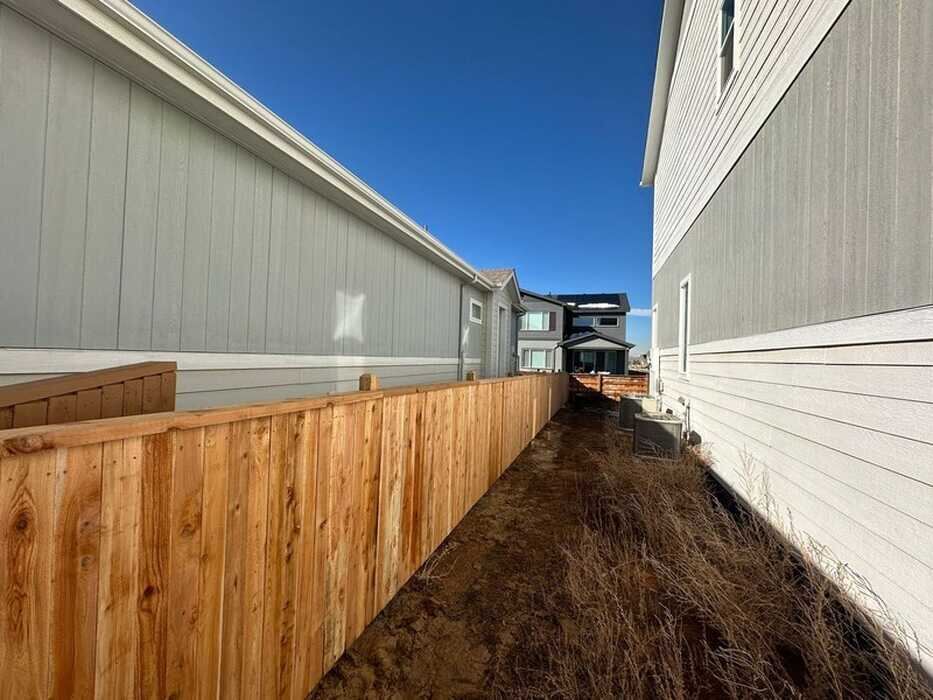
When chain link is the wrong call
We'll talk you out of chain link when it's not the right fence for what you actually want. Don't choose chain link if privacy is the goal: it's a see-through mesh, and slat inserts woven through it are a partial screen at best that fade and get brittle at our 5,400-foot altitude UV. For a real privacy screen you want cedar or vinyl, and that work lives on our dedicated Thornton fence installation page. If you're still weighing materials, our chain link vs. cedar vs. vinyl comparison breaks down cost, lifespan, and wind and clay durability side by side.
Don't order chain link inside an active HOA before you've checked the covenants either. Plenty of Adams County neighborhoods restrict or ban chain link in front-yard and street-facing runs, and building first and asking later is how homeowners end up tearing out a brand-new fence. If yours allows it, it's usually only the black vinyl-coated version, and we'll build the drawing and material list the committee asks for as part of the estimate. And if you just need one leaning section or a sagging gate fixed on an existing chain link run, that's a repair, not a replacement, and we'll quote the cheaper fix first.
What goes into a chain link fence, by name
Every estimate calls out mesh, gauge, posts, and gate spec by name. No vague allowance lines that turn into a fight at install.
How a chain link fence thornton project actually runs
Owner walk & written scope
The owner walks the property, measures, and asks what isn't working. You get a written scope with material specs by name — no allowance line items.
Design & selections
Layouts, material samples, and finish options reviewed in your space. Included in the project, not billed separately.
Permits & site prep
We pull the permit when one is required, protect existing surfaces, and prep the site. Surprises documented in writing before any change order.
Build with one crew
Same crew start to finish. Daily clean-up, dust control where needed, and a foreman you can text directly.
Walk-through & punch list
Written punch list signed by you. We don't take final payment until you sign off the walkthrough.
Ready to start your project?
Get a free chain link fence estimateWhat moves the price on a Thornton chain link fence
Chain link is the least expensive fence we install, but it's still not priced by linear foot alone. Mesh, gauge, height, and the dig all move the number, and the on-site estimate is free.
- $Galvanized vs vinyl-coated
Silver galvanized is the low-cost option; vinyl-coated black or green adds material cost for the cleaner look and extra corrosion layer.
- $Height & gauge
A 4-foot yard run costs less per foot than a 6-foot dog run or an 8-foot commercial perimeter, and heavier 9-gauge fabric costs more than 11-gauge.
- $Gates
Each gate adds a post and hardware; a double-drive or rolling commercial gate costs more than a single walk gate.
- $Corner & terminal bracing
Long agricultural and commercial runs need braced, deep-set corner posts, which adds crew time over a short bare-line yard run.
- $Dig, demo & access
Pulling old footings, a rocky lot, tight backyard access, and any permitted commercial run all add labor over a straight residential install.
Owner walks every fence estimate. Written, fixed price: the quote you sign is the price you pay.
Why chain link fails early in Thornton, and how we stop it
Nearly every sagging, leaning chain link fence we get called to fix in Thornton failed the same two ways, and neither is the mesh. The first is the end posts. A chain link run is pure tension, and all of it pulls on the terminal, corner, and gate posts. When those are set shallow or in tamped dirt, the fabric tension levers them inward over a couple of seasons, the top rail bows, and the whole line reads crooked. Our bentonite clay and the 30-to-36-inch frost line make it worse, grabbing a shallow post every winter. That's why we set every end post 36 to 42 inches deep in a full bag of concrete and brace the corners on long runs.
The second failure is the fabric itself, hand-pulled instead of stretched. Chain link that's tugged tight by hand and clipped on looks fine on install day and bags out into a saggy, wavy mess by its second summer. We stretch every run tight with a come-along and a stretcher bar and lock it to tension wire top and bottom, so the fabric stays taut for the life of the fence. Get the end posts deep and the fabric properly tensioned and a chain link fence in Thornton stays straight and tight for decades. Building a privacy fence instead of a see-through one? That work lives on our dedicated Thornton fence page, linked below.
Get a free chain link fence estimateRecent chain link fence thornton projects
Real homes, real scope, real craftsmanship — a snapshot of work delivered across the Denver metro.
Chain Link Fence Thornton across the Denver metro
Frequently Asked Questions
How deep are chain link fence posts set in Colorado?+
36 inches minimum, and 42 inches on 6-foot runs, in a full 50-lb bag of concrete, never tamped dirt. That applies to the terminal, corner, and gate posts that carry the run's tension. The Front Range frost line sits at 30 to 36 inches, and our bentonite clay swells and shrinks with the seasons, so a shallow end post heaves out of plumb the first hard winter and takes the top rail and fabric with it. Line posts run at 8-foot spacing so a stretched-fabric fence doesn't bow in a chinook.
What's the difference between galvanized and vinyl-coated chain link?+
Galvanized is silver zinc-coated steel mesh, the classic utility look and the least expensive option, right for back lines, kennels, and utility yards. Vinyl-coated is the same galvanized mesh with a bonded PVC coating in black or green: it costs a bit more but the black mesh visually recedes so the fence reads cleaner along a property line, the coating adds a corrosion layer over the galvanizing, and it's what most Thornton HOAs will approve when they allow chain link at all. We quote both side by side so you see the trade-off.
Do you install commercial and agricultural chain link fencing in Thornton?+
Yes. We build commercial and industrial perimeters, contractor and storage yards, and long agricultural property-line runs across Thornton and Adams County. Those step up from a backyard run: taller fabric, usually 6 to 8 feet, on heavier gauge, larger-diameter terminal posts braced with a rail and truss rod, optional barbed arms up top, and wide double-drive or rolling cantilever gates. If a commercial run tops 6 feet we pull the permit through the Adams County office on your behalf and call in locates before we dig.
What chain link fence heights and gate options do you offer?+
Heights run 4-foot for front and side yards and gardens, 5-foot as a backyard middle ground, 6-foot for dog runs and back property lines (the tallest without a permit), and 7 to 8-foot for permitted commercial perimeters. Gates include single walk gates for yard entries, double-drive gates for driveway and equipment access, and rolling cantilever gates on wider commercial openings. Every gate post gets a bag and a half to two bags of concrete for the swing load, and we hang each gate square before backfill so it latches on the first close.
How much does a chain link fence cost in Thornton?+
Chain link is the least expensive fence we install, but the price isn't just linear footage. The drivers are mesh (silver galvanized is the low-cost option, vinyl-coated black or green adds cost), height and gauge (a 4-foot 11-gauge yard run costs far less than a 6-foot 9-gauge dog run or an 8-foot commercial line), the number and type of gates, and the dig, since braced corner posts on long runs and old-footing demo add crew time. The owner walks every estimate and writes a fixed price before anyone breaks ground, so the quote you sign is the price you pay. Call (303) 915-8649 for a free on-site estimate.
Will a chain link fence keep my dog in the yard?+
For most dogs, yes, when it's built for it. We run 6-foot fabric for jumpers, use heavier 9-gauge mesh that stands up to a dog leaning and pawing at it, and pin the bottom tension wire tight to the ground because most escapes are dig-outs, not jumps. For a determined digger we can add a bottom rail or bury the fabric edge. Height alone isn't the whole answer, the bottom of the fence matters as much as the top.
Does an HOA allow chain link fencing in Thornton?+
It depends on the neighborhood, so check your covenants before you order. Plenty of Adams County HOAs restrict or ban chain link in front-yard and street-facing runs, and where it is allowed it's usually only the black vinyl-coated version, not silver galvanized. Building first and asking later is how homeowners end up tearing out a brand-new fence. If your HOA needs an architectural review, we build the drawing and material list they ask for as part of the estimate so there's nothing left to reject on a technicality.
We Also Serve
Get a free chain link fence estimate
One foreman, one written price, one schedule. Free on-site estimate from the owner.